Lesaka Secret Group
Ofrenda a la tormentaThe Lesaka Secret Group began as a commune for people seeking spirituality, traditional witchcraft, and communion with the forces of nature. Under the influence of Xabier Tabese, its language of belonging and ancient knowledge hardened into a system of sacrifice and permanent debt: members might scatter, but, according to the group’s doctrine, none could truly leave.
Formation and Recruitment
A former member recalled arriving in Lesaka at twenty-five, after university, with friends for San Fermín. A young woman invited them to the house she shared with others. At first, the place seemed like an unconventional commune: members explored tradition, humanity, and nature, grew marijuana, listened to the wind and the earth, and danced around a fire. The group held talks and invited possible recruits, including local people and tourists drawn by spirituality, Baztán witchcraft, magic, and spiritualism.
During that first summer, newcomers often heard about a man called Tabese and his teachings, but the witness did not meet him until September, after most of the summer visitors had left. The group invited him to stay. That invitation marked a change in his account: what had first appeared to be an open-ended search for tradition began to disclose a more controlling and demanding purpose.
Tabese’s Teachings and the Logic of Offerings
Tabese appeared unpredictably, and the witness did not know where he lived or when he would return. His arrival turned into an occasion for celebration; in his absence, members waited for him. The witness described him as wealthy, impeccably presented, seductive, and commanding. He recalled that the group loved Tabese and would have done anything he asked, while Tabese supplied precise instructions about what to do and how to do it.
Tabese presented the group’s practices as a recovery of ancient witchcraft and forgotten religion. He spoke of extraordinary beings long present in the region, of megalithic markers and ley lines laid out by the first inhabitants of Baztán, and of Watkins’s dating of those alignments to the Neolithic. The members, he taught, could awaken these powers through offerings and thereby obtain what they wanted. The relationship was framed as an old, mutually beneficial exchange: people gave offerings, initially small animal sacrifices performed in prescribed ways, and received favors in return.
The witness said the first apparent favors made members feel powerful, but that each new benefit brought a demand for more. The group’s teachings thus turned success into evidence for its supernatural claims and into a reason to accept escalating obligations. The witness described nearly a year of access to extraordinary knowledge, power, and experiences before recalling the sacrifice he could not bring himself to discuss directly.
Sacrifice and Ritual Rules
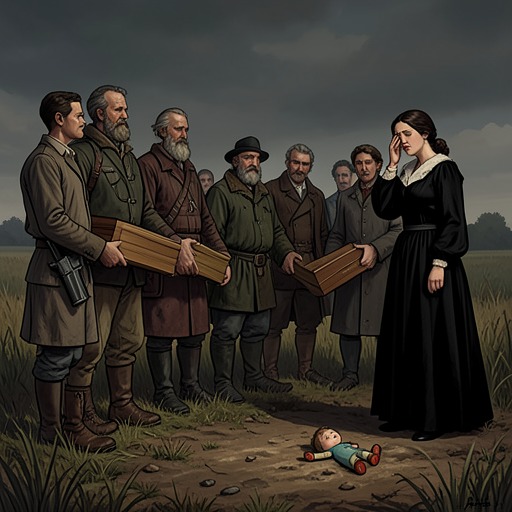
The testimony describes a young girl whose own parents offered and killed her, as the group required. The witness said that the child’s body was taken away after the ritual. In a later explanation, he connected the killing to Inguma: the victim had to be deprived of air, as Inguma was, and the body then had to be surrendered as an offering. He did not know the purpose of the act beyond the group’s prescribed requirements.
The rules described in the testimony specified a girl under two years old who had not been baptized. Baptism was understood as an offering and commitment to another god, incompatible with the group’s own offering. The age rule rested on a belief in transition: from birth until the second year, children were considered to move between two worlds and to be able to perceive both, making them suitable vehicles for communication with spiritual realms. The witness also described infancy as a period in which the soul remained in transition and the child was especially valid as an offering. He said the group claimed that sacrifices were organized by sex and age, and that Inguma took victims in cycles under matching circumstances.
The group’s ritual logic treated a child’s status as decisive: age, sex, baptism, manner of death, and the surrender of the body all formed part of the prescribed act. These were the members’ stated beliefs, not independently verified supernatural effects. Their practical force, however, is clear in the testimony: ritual doctrine dictated what the group required of its adherents and how the sacrifice was carried out.
Membership, Obligation, and Dispersal
After the sacrifice, the group began to break apart. Members disappeared within less than a month; Tabese never returned, and the witness was among the last to leave. By then, only the couple who had made the offering remained. The apparent collapse did not, in the group’s own account of its obligations, amount to release. The witness later said that the members had dispersed as part of their agreement but had never stopped belonging, and that sooner or later Inguma would collect an offering from everyone. No one, he maintained, was exempt, however much time passed.
The witness connected this belief in unavoidable payment to his later life. Years after leaving, he encountered a former group member among the doctors treating his eight-year-old son for cancer. The doctor said the illness could be solved if the witness made a sacrifice. The witness admitted that his child’s suffering brought him close to considering it, but said his son died a few months later. A week after the death, he went to a police station and confessed. He described the losses that followed his denunciation: his work and money, his wife and home, and his friends. His testimony presents the group’s debt not as a completed obligation but as a threat that continued to shape the lives of former members.
Control and Significance
A later account of destructive sects describes how such groups identify people with particular vulnerabilities, exploit their needs, and remake them within a circle that promises love, protection, respect, and a place in the world. The Lesaka testimony gives that analysis concrete form: recruits first encountered fellowship, spiritual exploration, and access to special knowledge; under Tabese, belonging became obedience, favors became debts, and the possibility of departure was denied by doctrine. The group’s power lay not only in its ritual rules but also in the promise that members mattered within a community that claimed to understand forces beyond ordinary life.
The witness’s account also exposes the human cost concealed by the language of exchange. A sacrifice was presented as the price of benefits, while the child’s death and the parents’ participation were absorbed into the group’s prescribed order. Later, even dispersal could be interpreted not as an end but as a deferred reckoning. The Lesaka Secret Group is therefore defined by a sharp contradiction: it offered recruits belonging and power, yet bound those promises to violence and to an obligation its doctrine declared impossible to escape.